When Charge Takes Patients, Who Takes the Unit?
Published · California Nursing Observatory · 6 min read
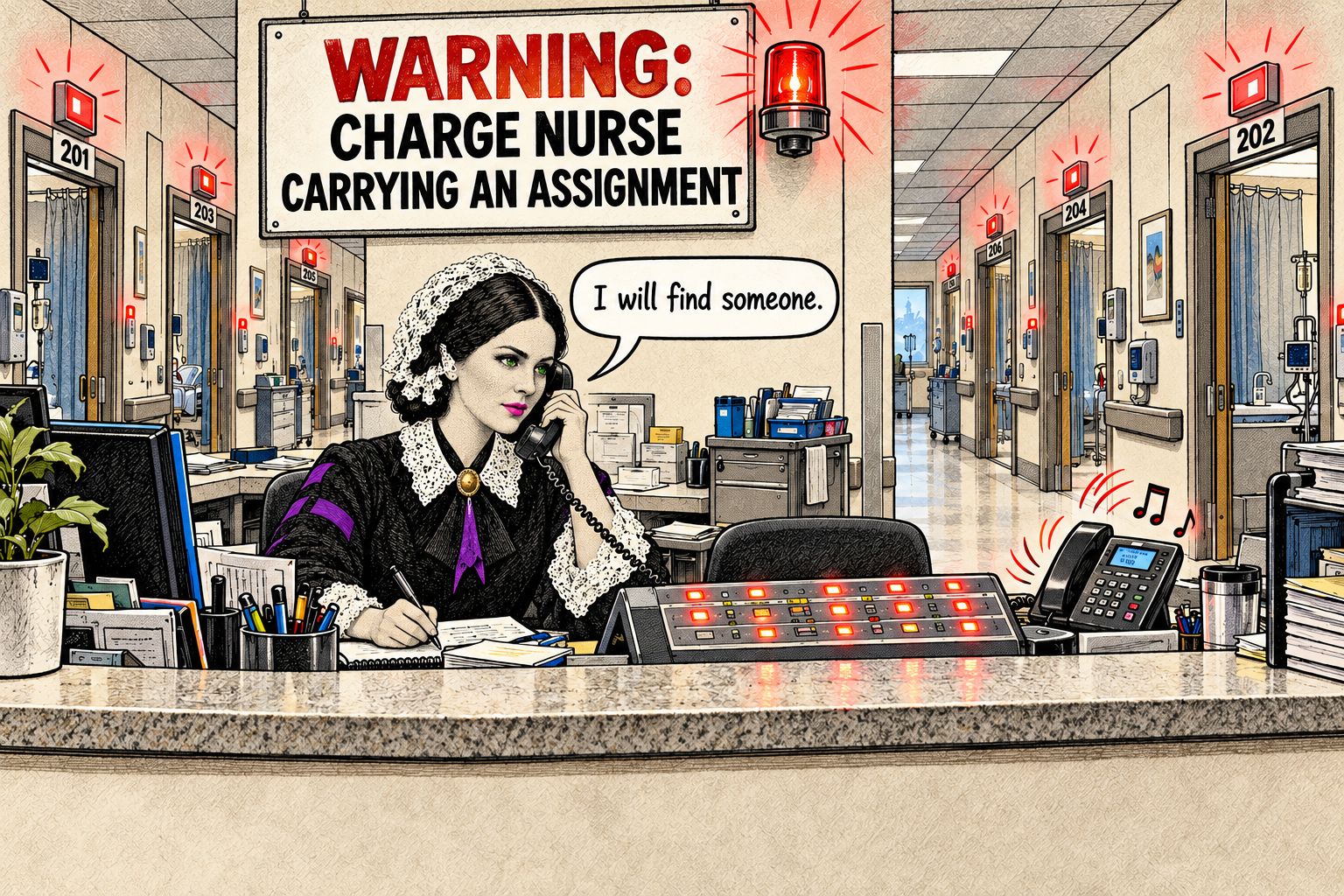
A charge nurse is a unique creature in the medical world.
Imagine you’re a nurse: four of your patients are calling for you at once, a doctor wants answers he could find in your notes if he read them, and an irate family member is heading straight toward you, full urinal in hand.
Now imagine someone standing between you and the chaos, someone who runs interference and answers your incredibly important questions: Can I hang cefazolin with lactated Ringer’s? Can you look at this tracing? Who can help me get this IV?
That’s your charge nurse.
She’s the nurse responsible for coordinating the unit for that shift. Some readers may know the term “head nurse,” although titles and responsibilities vary. If you’ve ever wondered why she doesn’t have patients of her own, pull up a chair.
She already has a job.
In labor and delivery, where I worked for years, the charge nurse needed to know what was happening in every room and what was likely to happen next. Who was getting close to delivery? Who was becoming concerning? Who was coming in? Who needed to go somewhere else? Could a case reasonably wait two hours, when staffing would make more sense?
She coordinated transfers in and out and organized people for surgery. When you had a high-risk delivery, you knew she was paying attention to your room and making sure the baby nurse and additional help were getting there.
She was also the face of the unit, whether she wanted to be or not. Families brought her complaints, physicians came to her for help, and anyone searching for the left-handed Metzenbaum scissors expected her to know where they were. People brought her problems all shift long, and very few of those problems made an appointment.
Where I worked, she reevaluated staffing every four hours using a staffing matrix, kept handwritten notes documenting whom she had called for help and what they said, and recorded who had been placed on call and when. She also completed computer reports, arranged coverage for breaks and lunches, and worked on ensuring the oncoming shift had enough staff. Someone looking across the nurses’ station might see her sitting at a computer without realizing that she was working out how to keep the unit staffed through the rest of her shift and into the next one.
In the L&D unit where I worked, you needed about a decade of experience before working as a charge nurse, and I had those years behind me by the time I took on the role. That experience mattered to everyone on the unit: an experienced charge nurse could help assess a concerning patient, get a difficult IV started, or find the person who could. While you were absorbed in your own room, she needed to hold the whole unit in her head.
In my experience, by the time the charge nurse took a patient assignment, everybody else was at maximum capacity. It could happen gradually as a busy unit kept taking more patients, until you looked up from your own work and realized she now had a patient—or two—of her own. She had been the unit’s pressure-relief valve, and now that capacity was committed, too.
When you have your own assignment, you become absorbed in those two or three rooms because your patients need your attention. Meanwhile, little pockets of trouble can develop quickly elsewhere in labor and delivery, and someone needs to remain available to recognize what is happening and organize help. Giving her a patient assignment divides the attention she needs to keep track of the whole unit.
We occasionally reached an extraordinary level of demand, with two ORs already in use and a third crew being assembled. Those rare situations could consume every available person. I saw nurses calling colleagues at home in the middle of the night, including people who weren’t on call, and begging them to come in. That was an exceptional surge; the recurring shortage was less spectacular, with everyone at capacity, the charge nurse taking patients, and nobody available to relieve you.
When the charge nurse had her own assignment, she couldn’t cover your patients because she had patients who needed her, too. Sometimes cafeteria trays arrived at the nurses’ station, where we ate while charting and watching fetal heart rates and uterine activity on the monitors. We stayed where we could keep watching because we were still responsible for our patients. The food arrived, but the relief didn’t.
This happened off and on for a decade as staffing improved and deteriorated again. The difference between struggling through a shift and having enough support was unmistakable, but even when things improved, it was difficult to trust that the improvement would last.
Professional standards recognize the need to protect the charge nurse’s availability. The American Association of Critical-Care Nurses’ adult critical-care staffing standards, published in 2024, and adult progressive-care standards, published in 2025, specify that clinical leaders such as charge nurses should not take patient assignments except in rare crises. These standards recognize that overseeing the unit is work that requires time and attention of its own.[1, 2]
Research also describes what nurses lose when that support is unavailable. In a qualitative study of 16 medical-surgical nurses at a US community hospital, a charge nurse having a patient assignment was identified as a barrier to obtaining additional expert help with a patient. The concern extends beyond how many patients each nurse carries to whether someone experienced is available when another nurse needs help.[3]
The support available to the charge nurse matters, too. I worked with an excellent, experienced LVN whose help made carrying a patient assignment while working as a charge nurse manageable. There were also times when a charge nurse could take a patient for a scheduled NST—a fetal monitoring test—and handle the visit from beginning to end without adding it to another nurse’s workload. The important question is whether she still has the time and support to oversee the unit while meeting her own patients’ needs.
Hospitals could make this visible by reporting how often the charge nurse carries a patient assignment, how long it lasts, and who provides the unit-wide support during that time. Coverage for breaks and lunches belongs in that accounting, too, because a charge nurse covering other nurses’ patients may spend much of the shift committed to bedside care even without an assignment of her own.
A staffing number can tell you how many nursing hours were reported without telling you who was available when help was needed. California allows a charge nurse to count toward bedside ratios while providing direct care, but excludes her while she performs other duties.[4] Giving her patients may fill a gap at the bedside, but it creates another: who is watching the unit and coordinating help? Hospitals should explain how they count her hours and who covers those responsibilities when she has a patient assignment.
To someone reviewing staffing from a distance, an assignment-free charge nurse might look like an available person who could take more patients. From inside the unit, she is already coordinating the care underway and preparing for what comes next. When she takes patients, the transfers, staffing decisions, requests for help and emergencies continue to demand her attention, even while her own patients need her at the bedside.
The longstanding fight between nursing and the budget office comes down to this: corporate keeps nibbling away at the edges of patient safety to save on staffing, and the charge nurse’s availability is one more thing on the table.
Hospitals should document and publicly report how often charge nurses carry patient assignments, how large those assignments are, and what backup is available to them. That information would tell nurses something a staffing total alone cannot: whether the person responsible for overseeing the unit has the capacity to do so. A charge nurse’s assignment deserves attention as a staffing indicator because it reveals how the hospital distributes its nursing resources—and how much support remains when someone needs help.
Bibliography
- American Association of Critical-Care Nurses. Standards Published for Critical Care Nurse Staffing. April 23, 2024.
- American Association of Critical-Care Nurses. Progressive Care Staffing Standards Published. April 29, 2025.
- Harton L, Skemp L. Have our backs—medical-surgical nurses’ safety culture experiences: An inductive qualitative descriptive study. Nursing Open. 2024;11:e2095.
- California Code of Regulations, title 22, §70217: Nursing Service Staff.